
Embedding Governance into AI Agent Workflows: The Allowix Approach to Bounded Execution
The Problem with Unconstrained Agent Autonomy
Enterprise teams evaluating agentic AI platform solutions face a genuine architectural tension: the business value of an AI agent comes from its autonomy, but autonomy without deterministic constraint is a compliance and liability problem. A customer service or operations agent that can autonomously execute API calls to send emails, modify CRM data, or process financial refunds without oversight is either deeply valuable or deeply dangerous depending entirely on whether it makes the right sequence of decisions.
Most agent frameworks and initial enterprise AI implementations address this tension with guardrails added after the fact. They rely on rate limits, basic logging, and post-hoc review workflows. When things go wrong, the engineering team investigates the logs to understand what the agent decided and why. This reactive model is fundamentally broken for enterprise risk profiles.
Allowix's approach to enterprise AI agent governance is structurally different. Governance is not supplementary. Governance is the foundational runtime constraint. We define this approach as "bounded execution."
What Bounded Execution Means in Practice for Governed AI Platforms
Bounded execution means that an AI agent's action space is explicitly defined, enumerated, and permitted before it executes, not discovered dynamically during execution. Every action the agent can take, every tool it can call, and every data element it can modify is defined in a deterministic policy configuration. Any action outside that defined set requires escalation to a human reviewer, regardless of the agent's internal confidence score.
This architecture has three practical consequences for enterprise AI agent governance:
- 1. Predictability over Autonomy. An agent operating within bounded execution cannot surprise you with novel, unapproved workflows. It can only execute the actions you have explicitly permitted. When an unexpected scenario arises—one not covered by the defined action space—the agent escalates rather than improvising. This shifts the enterprise risk from "what will the agent do?" to "how well does the agent handle the workflows we approved?"
- 2. Verifiable Auditability. Because the action space is defined and enumerated before execution, AI agent permissions and audit trails are complete and structured against a known schema. Compliance reviews are not forensic exercises involving unstructured chat logs. They are structured database queries against the policy engine's execution record. Every action executed is logged with the precise policy context, confidence score, and input parameters that authorized it.
- 3. Workflow Composability. Bounded agents can be composed into multi-agent workflows with clear handoff contracts. If Agent A's output space is deterministically bounded, Agent B's input space can trust the format and constraints of that output. The boundaries are defined at design time, enabling complex workflows without compounding probabilistic execution risks.
The Allowix Policy Engine: A Three-Layer Governance Architecture
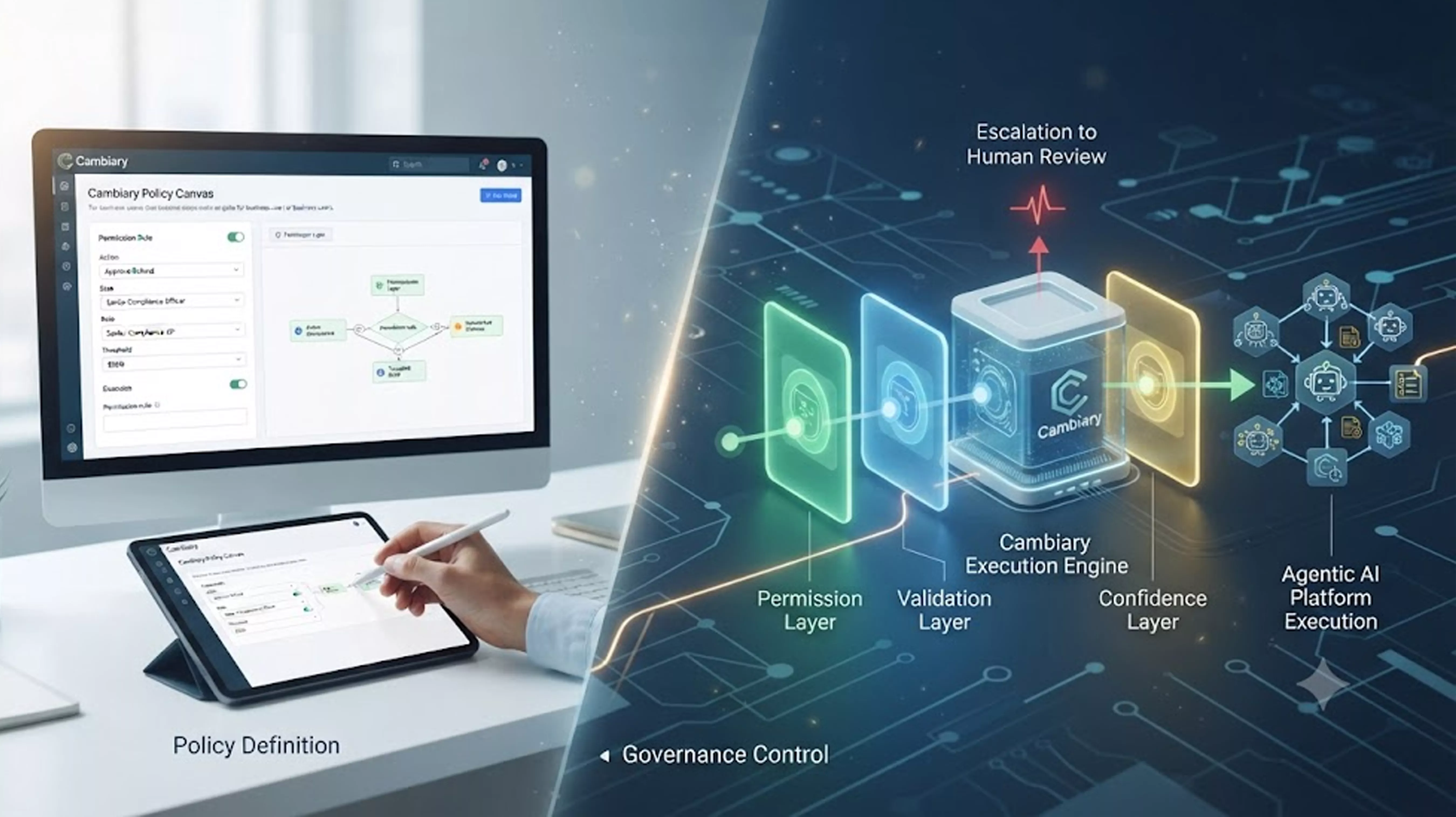
Allowix structures agent governance through a policy engine that evaluates every proposed agent action against three deterministic layers before the action is passed to the execution environment. This is how to implement guardrails for autonomous AI agents that satisfy enterprise compliance requirements:
1. The Permission Layer
This layer evaluates whether the proposed action falls within the agent's explicitly granted action set for the current tenant and role context. If an agent is authorized to retrieve an invoice but not approve it, an approval action is blocked here before any business logic validation occurs. This is strict Role-Based Access Control (RBAC) applied to the agent's tool execution layer.
2. The Validation Layer
If the action is permitted, this layer evaluates whether the action's input data satisfies the defined schema constraints and business rules. If the action is "Approve Refund," the validation layer checks if the refund amount falls within the policy-defined maximum. This layer executes deterministic business logic, not probabilistic evaluation.
3. The Confidence Layer
If the action is permitted and validated, this final layer evaluates whether the agent's own confidence score regarding the action meets the threshold defined for autonomous execution. Actions that fall below the threshold—or actions defined as requiring mandatory human review regardless of confidence—are queued for human approval.
Actions that pass all three layers execute immediately. Actions that fail at any layer trigger an escalation workflow. The human reviewer receives the full context: the agent's reasoning, the proposed action, the specific data parameters, and the exact constraint layer that triggered the escalation.
Solving Governance Challenges in Governed AI Platforms with No-Code Authoring
The governance model outlined above only works if non-technical domain experts—compliance officers, operations managers, legal teams—can participate directly in defining the agent's boundaries. If policy rules are buried in code, governance is slow and misaligned with business intent.
One of the primary governance challenges in agentic AI platforms is the translation gap between a business policy and the corresponding technical guardrail. Allowix's no-code authoring interface solves this by allowing business users to define agent action sets, approval thresholds, data validation rules, and escalation pathways using structured, human-readable forms. The policy engine consumes these definitions directly at runtime.
A compliance team can specify exactly what a claims processing agent is permitted to do, which fields it can modify, and what its autonomous approval limit is, without writing policy code. The result is a governance model that business stakeholders own and engineering teams execute.
Conclusion
Enterprise AI adoption stalls when governance is treated as an afterthought or a secondary feature. Allowix's bounded execution model makes deterministic governance the foundation of the platform, not a layer added after the agent is already in production.
The result is faster enterprise deployment, not slower. When the compliance, legal, and security review processes can evaluate a concrete, deterministic policy engine rather than an open-ended, probabilistic autonomy claim, the path to production approval becomes clear. This is the difference between a prototype and a production agentic AI platform.
See governed agents in your own product.
Book a demo and we'll walk your team through the governance model, the two-seam integration, and a use case for your industry.