
Governing Autonomous AI Agents: Policy Engine Design Patterns for Bounded Execution
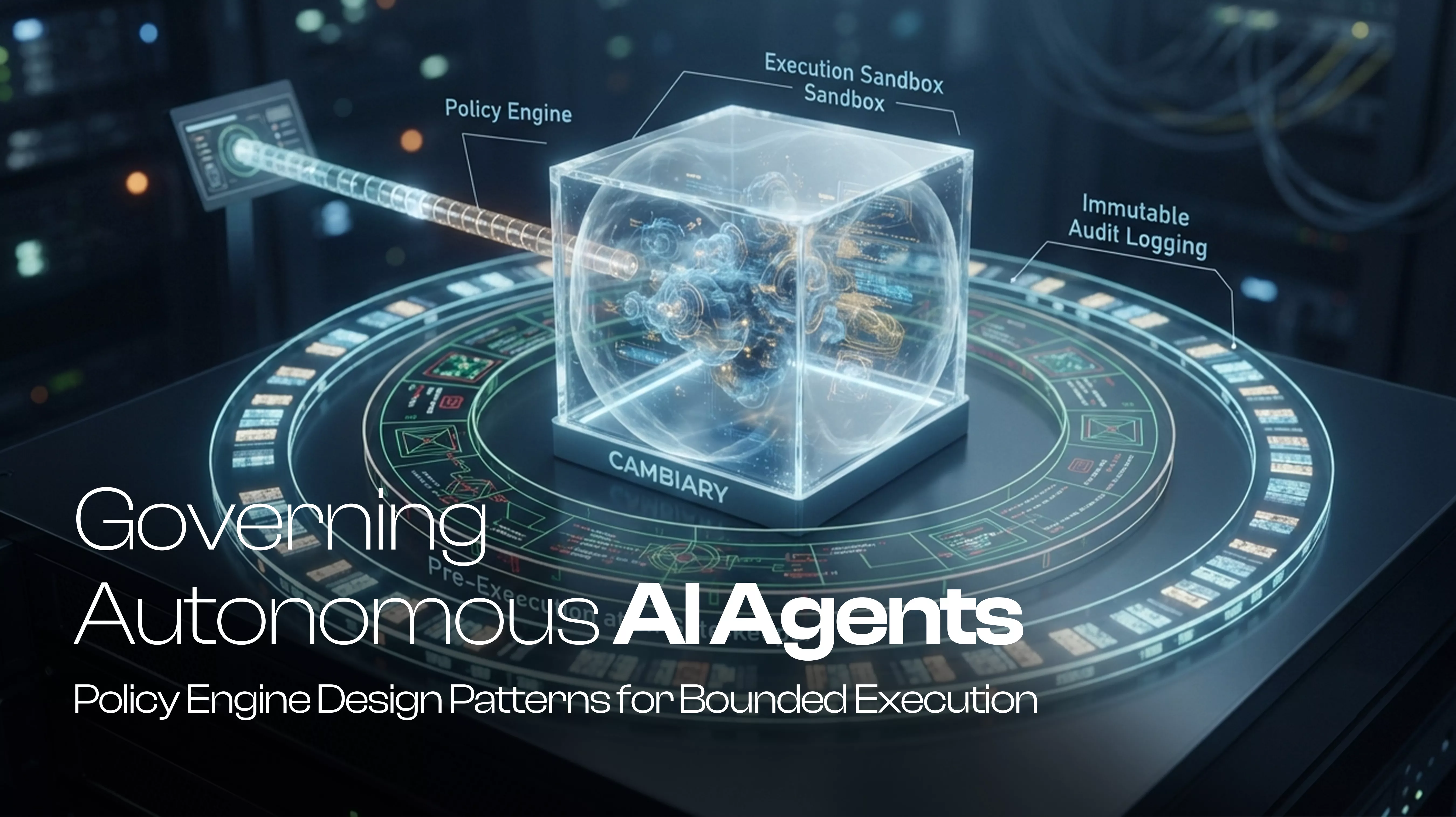
As enterprise organizations transition from simple conversational chatbots to autonomous task execution agents, governance has emerged as the single greatest barrier to production deployment. Granting an AI agent write permissions to production APIs, customer databases, or financial workflows without strict deterministic policy boundaries introduces severe operational, financial, and regulatory risks.
In 2026, enterprise IT leaders no longer ask if AI agents can execute tasks; they ask how to bound agent execution so an autonomous error cannot compromise the business.
This paper presents the core architectural framework behind Allowix—the enterprise agentic AI platform—detailing how to design deterministic policy engines, bounded execution sandboxes, and immutable audit trails for autonomous software agents.
The Core Risk: Unbounded Non-Deterministic Reasoning
Large Language Models (LLMs) are inherently probabilistic reasoning engines. While they excel at natural language understanding, context synthesis, and dynamic tool selection, they lack hard deterministic guarantees.
When an LLM is wired directly to an external API (e.g., executing a refund, updating employee records, or altering inventory allocations), three primary failure modes occur:
- Hallucinated Parameter Mutations: The model generates syntactically valid but logically destructive API payload parameters.
- Cascading Tool Loops: The agent enters recursive tool-calling loops that consume excessive API quotas or trigger repeated state changes.
- Privilege Escalation: An attacker uses prompt injection to trick the agent into executing API actions beyond the scope of the requesting user.
To solve this, enterprise architecture must treat LLM reasoning as an untrusted proposal engine, governed by a hard deterministic policy boundary.
The Allowix 3-Layer Governed Architecture
To achieve zero-breach autonomous execution, Allowix enforces a strict three-layer architectural pattern between the user prompt, the LLM, and downstream enterprise APIs:
1. Pre-Execution Policy Gatekeeper
Evaluates agent tool calls against static business rules before API execution.
- Parameter Boundary Enforcement: Ensures numerical parameters (e.g., discount amounts or credit limit changes) fall strictly within pre-approved thresholds.
- Role-Based Scope Matching: Validates that the user who initiated the agentic session possesses the explicit IAM permissions to execute the target API action.
- State Mutual Exclusion: Blocks actions that violate business rules regardless of model confidence.
2. Bounded Execution Sandbox
Approved tool calls execute inside an isolated runtime sandbox with bounded resource access:
- Rate-Limiting & Quota Controls: Prevents infinite loop execution by enforcing maximum step counts per task.
- Idempotency Keys: Attaches unique transaction tokens to API calls to prevent double-execution during network retries.
- Environment Isolation: Executes code or database queries in temporary, read-only ephemeral containers when evaluating data.
3. Immutable Audit & Reversal Logging
Every agent decision path must be fully auditable for security reviews and compliance verification under regulations like the EU AI Act (Article 14).
Allowix records complete prompt history, raw tool-call proposals, policy evaluation decisions (PASS / REJECT / ESCALATE), and human sign-off timestamps for gated workflows.
Human-in-the-Loop (HITL) Gate Patterns
Complete autonomy is appropriate for low-risk, easily reversible tasks (e.g., drafting an email summary or tagging a ticket). For high-impact operations, Allowix implements a Dynamic Confidence Threshold Gate.
When an agent's confidence score drops below a designated policy threshold or touches a sensitive API endpoint, execution pauses automatically. An interactive notification is dispatched to a designated human expert with full context, enabling one-click approval, modification, or cancellation.
Code Example: Policy Schema Enforcement
Here is a simplified example of how Allowix defines deterministic boundary checks for an automated customer refund agent:
// Allowix Deterministic Policy Rule for Refund Agent
export const RefundPolicyRule: PolicyRule = {
  name: "EnforceMaxRefundThreshold",
  targetTool: "issueCustomerRefund",
  evaluate: (context, payload) => {
    // 1. Hard parameter check
    if (payload.amount > 500) {
      return {
        status: "ESCALATE_TO_HUMAN",
        reason: "Refund amount exceeds auto-approval threshold of $500."
      };
    }

    // 2. User permission verification
    if (!context.userPermissions.includes("CRM.Orders.Refund")) {
      return {
        status: "REJECT",
        reason: "Requesting user lacks CRM.Orders.Refund permission."
      };
    }

    return { status: "APPROVED" };
  }
};
Frequently Asked Questions
Q: Why can't we rely on system prompts to enforce safety rules?
A: System prompts are probabilistic instructions, not hard constraints. Adversarial prompt injection attacks or unexpected context shifts can cause the model to ignore system prompt instructions. Hard security boundaries must always exist outside the model.
Q: Does adding a policy gatekeeper introduce noticeable latency?
A: No. Deterministic code evaluations (schema checking, range validation, and permission lookups) execute in milliseconds, representing less than 1% of the overall LLM inference latency.
Q: How does Allowix handle compliance for enterprise AI deployments?
A: Allowix provides native compliance reporting tailored to the EU AI Act and SOC 2 Type II controls, generating immutable event logs and human oversight records for every active agent.
Summary & Architectural Takeaway
Autonomous AI agents represent the future of enterprise software, but their adoption depends entirely on governance. By decoupling reasoning from execution using Allowix's 3-Layer Policy Architecture, enterprise development teams can ship powerful autonomous capabilities with complete operational confidence.
Building agentic workflows for your enterprise platform?
See governed agents in your own product.
Book a demo and we'll walk your team through the governance model, the two-seam integration, and a use case for your industry.